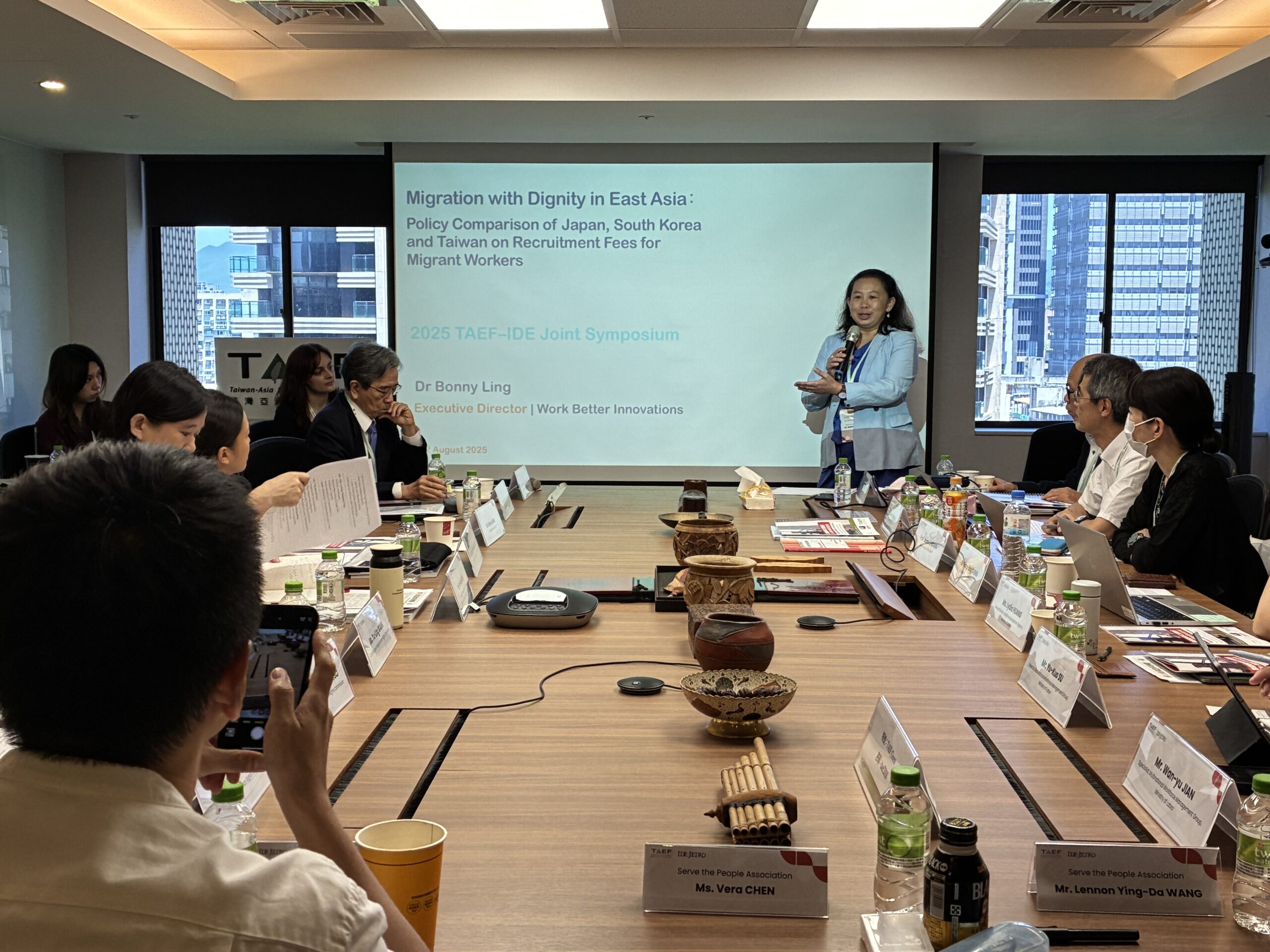
25 August 2025. WBI was honoured to present our policy brief on migration with dignity in East Asia focusing on recruitment fees policies in Japan, South Korea and Taiwan at an international symposium in Taipei on 22 August 2025.
The symposium, hosted by the Taiwan Asia Exchange Foundation (TAEF) and Japan External Trade Organization’s Institute of Developing Economies, brought together Taiwanese and Japanese scholars, government officials, and civil society organisations to identify and explore solutions to challenges facing migrant workers in the region. This event followed the launch of our policy brief earlier in April this year.
We launched the Japanese version of WBI-TAEF joint policy brief, Migration with Dignity in East Asia: Policy Comparison of Japan, South Korea and Taiwan on Recruitment Fees for Migrant Workers, analyses recruitment fee practices and regulations across the three countries. The policy brief is available in Traditional Chinese, English and Japanese which is translated by CRT Japan.
The symposium opened with a keynote address by Mr. Sun-Han Hung, Minister of Labor of Taiwan, who spoke of the government’s ongoing efforts and challenges associated with reforming migrant recruitment in Taiwan. Mr. Hung called for innovative approaches and collaboration with labour-sending countries, government departments and businesses to transform existing systems.
The symposium featured a diverse panel of scholars:
- Professor Izumi Chibana, IDE-JETRO
- Ms. Renee Cheng, University College London (UCL)
- Dr. Yu Fan Chiu, Associate Professor, National Yang Ming Chiao Tung University
- Professor Keizo Yamawaki, Meiji University
- Dr. Bonny Ling, Work Better Innovations

For Taiwan, participants included representatives from the Ministry of Labor’s Workforce Development Agency, Taiwan’s National Human Rights Commission, business alliances, and civil society organisations—all critical stakeholders in shaping labour reform in Taiwan.
Participants discussed how the employment and management of migrant workers in Taiwan rely heavily on labour agencies, in part due to the complexity of cross-border hiring policies. Addressing these challenges will require joint efforts to explore innovative pathways.
Compared to its regional neighbours of Japan and South Korea, Taiwan has a relatively simple labour migration landscape with only four formal corridors from Indonesia, the Philippines, Thailand and Vietnam. This comparatively straightforward migration landscape makes Taiwan the ideal candidate to be the incubator of innovative solutions and pathways.
–Dr. Bonny Ling
In addition to our policy brief, Dr. Ling co-presented with Ms. Renee Cheng the paper The Cost of Migration: Making the Human Security Case for Migrant Workers in Taiwan, published by the Taiwan Research Hub, University of Nottingham in May 2025. This work further argues for strengthening human security and rights protections for migrant workers in Taiwan.
This was an important dialogue. We are encouraged by the shared commitment of policymakers and civil society actors. Advancing labour reform requires genuine engagement with diverse stakeholders and an understanding of their different capacities and concerns.
It also demands determination and innovation, particularly in the face of economic uncertainty and the growing pushback against business and human rights in some jurisdictions.